Concept to Resortwear: How to Make a Tech Pack for a Linen Shirt Dress (Free 14-Page PDF)
Md.shakibul islam Shawn
Author
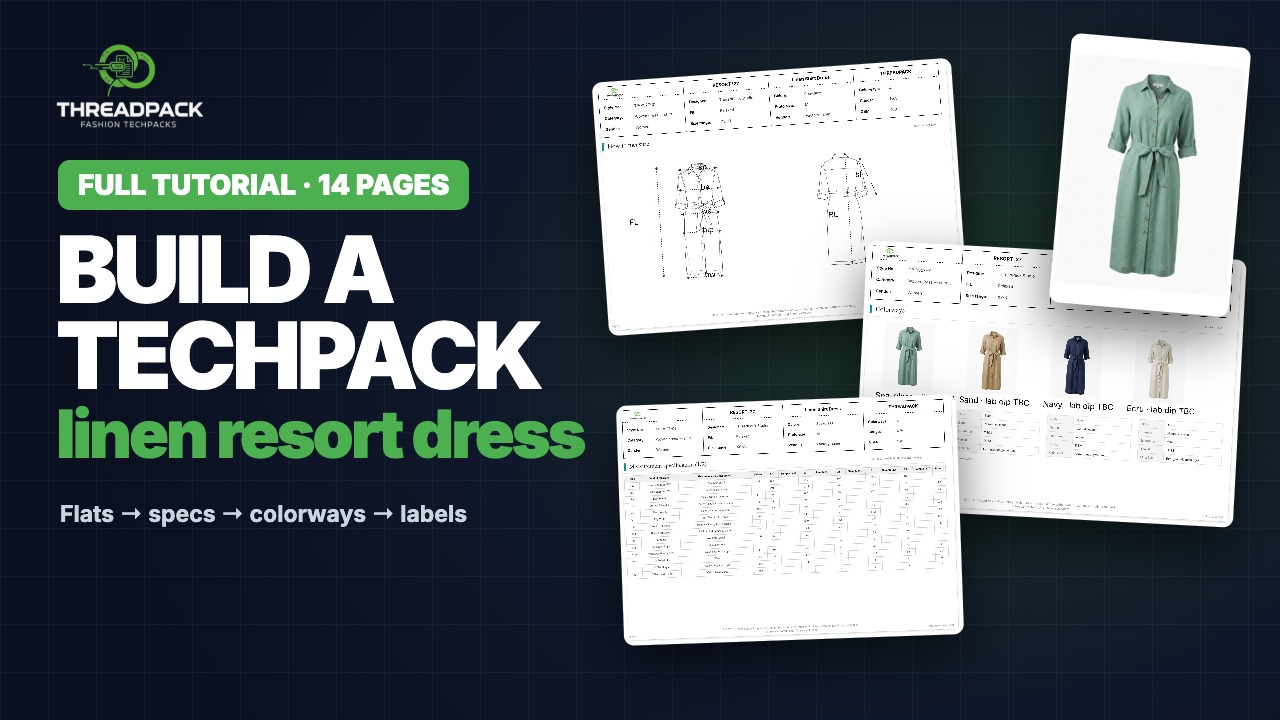
A tech pack is the document a factory builds your garment from. For a linen resort shirt dress, a complete tech pack has 14 pages: overview, flat sketches with key details, construction, a graded measurement spec, size chart and order, how to measure, fabric and trims, bill of materials, colorways, labels, quality control, inspection and testing, and packaging. This guide builds every one of those pages for a real style, step by step, in ThreadPack.
Watch the full tutorial: How to Make a Tech Pack: Linen Resort Shirt Dress, All 14 Pages (8 minutes, real screen, nothing faster than 2×).
Get the finished file: the complete 14-page PDF of this tech pack is free to download at the end of this post.
Quick answer: what goes into a linen shirt dress tech pack?
- Style header: season, style number, category, fit, size range, base size and fabric weight, repeated on every page.
- Flats and details: front and back technical flats with numbered callouts.
- Construction: seam types, stitch class (ISO 301 lockstitch) and stitches per inch.
- Measurements: every point of measure for XS–XL, the grade between sizes and the tolerance.
- Materials: fabric (100% linen, plain weave, 160 GSM), trims and a bill of materials.
- Colour, labels, QC and packing: colorways with lab dip status, care and size labels, AQL checks, fabric tests and packing instructions.
Part 1: From concept to design
1. Start with a moodboard
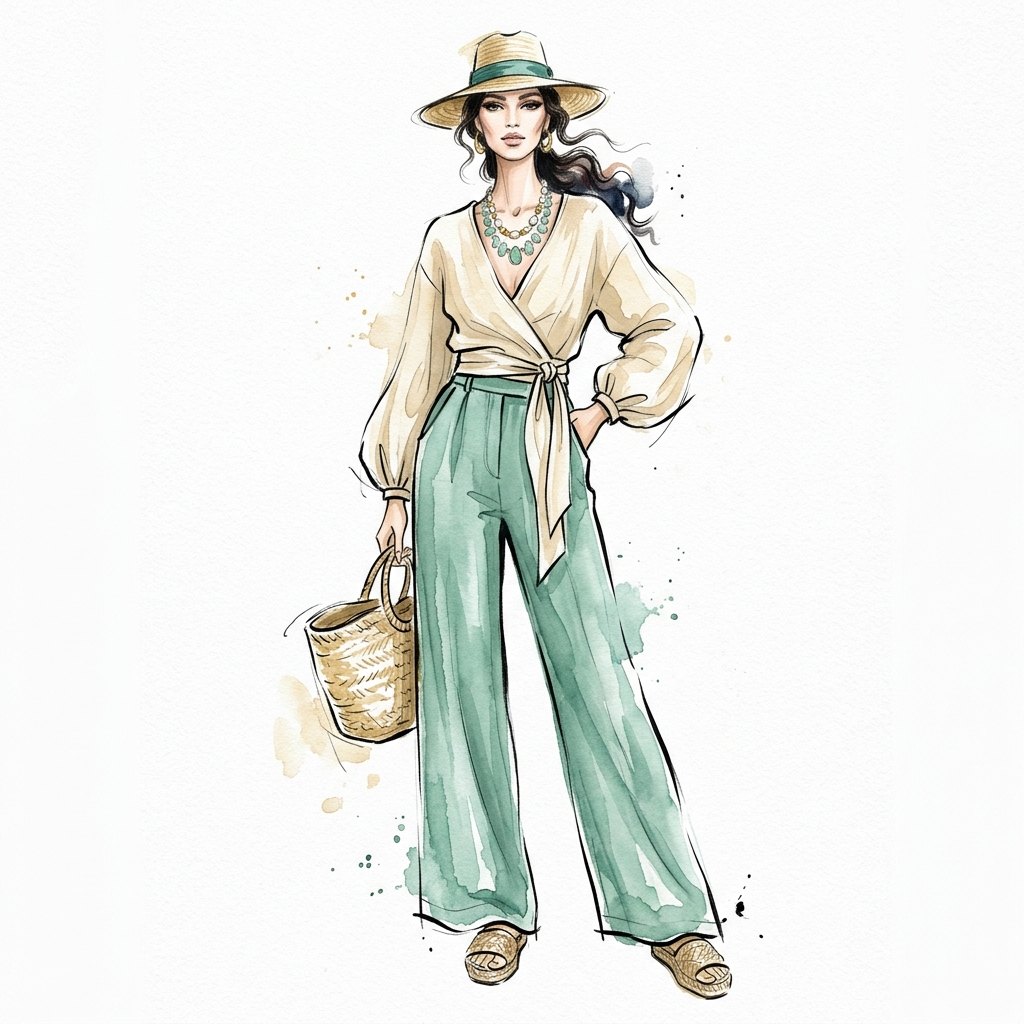
In the AI Assistant, choose Moodboard and type one sentence: "Coastal summer resort: washed linen, sun-bleached neutrals, sea-glass green." In about a minute you get a concept board with a hero garment, a fabric close-up, a styled look and a four-colour palette. That palette (sand, sea-glass, sage and deep green) becomes the colour story for the drop.
2. Generate design options and pick one
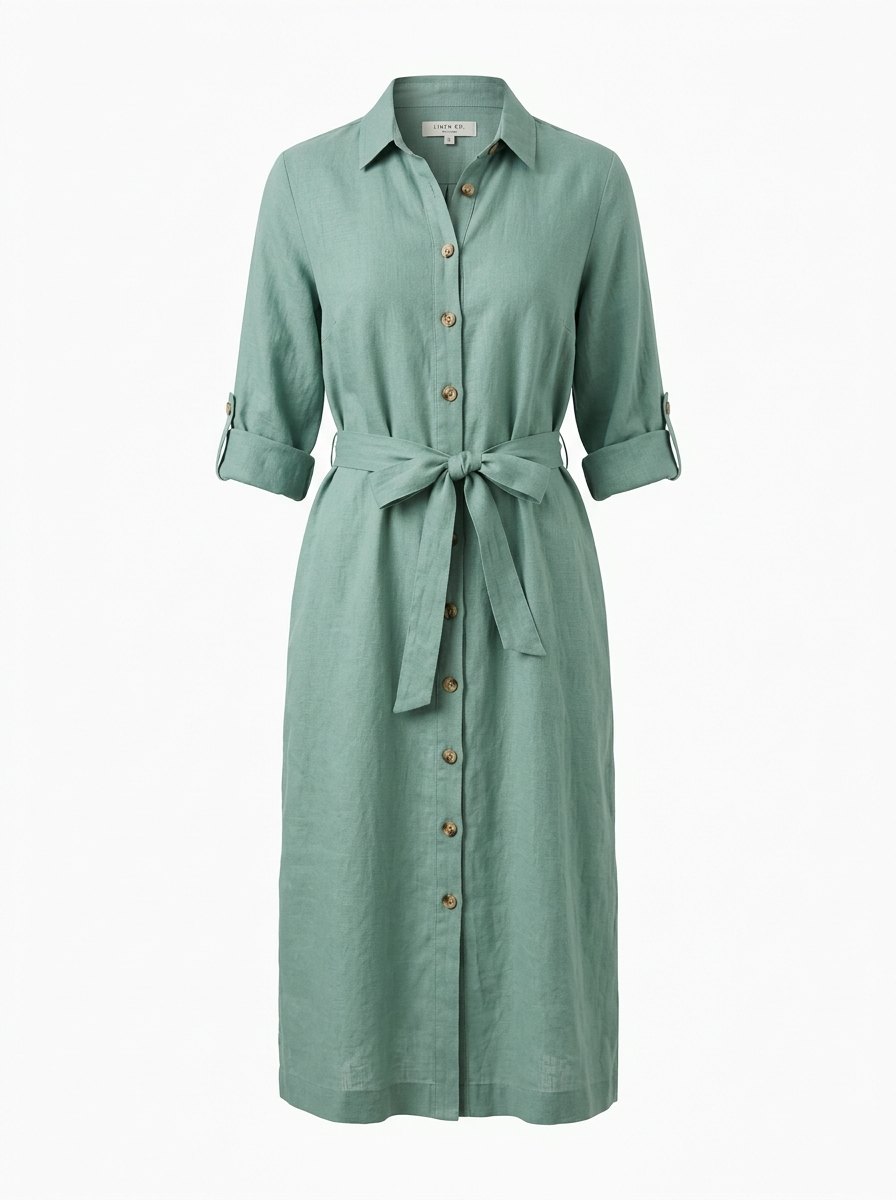
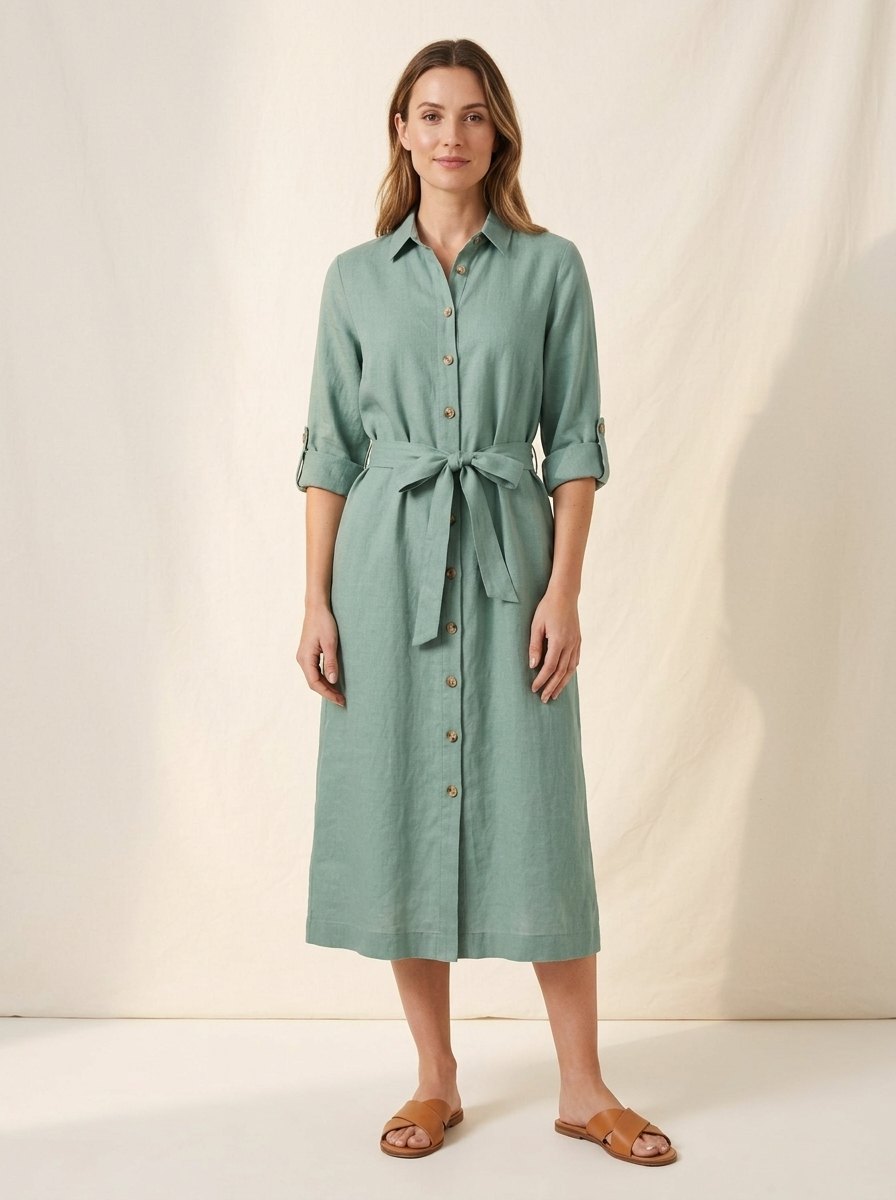
With Text to Image set to Product photo and 3 options, describe the garment: "women's relaxed linen shirt dress, sea-glass green, rolled sleeves, coconut buttons, tie waist, midi length." Tick only the option you like. Only that one goes onto your page.
3. Turn it into a technical flat and a model shot
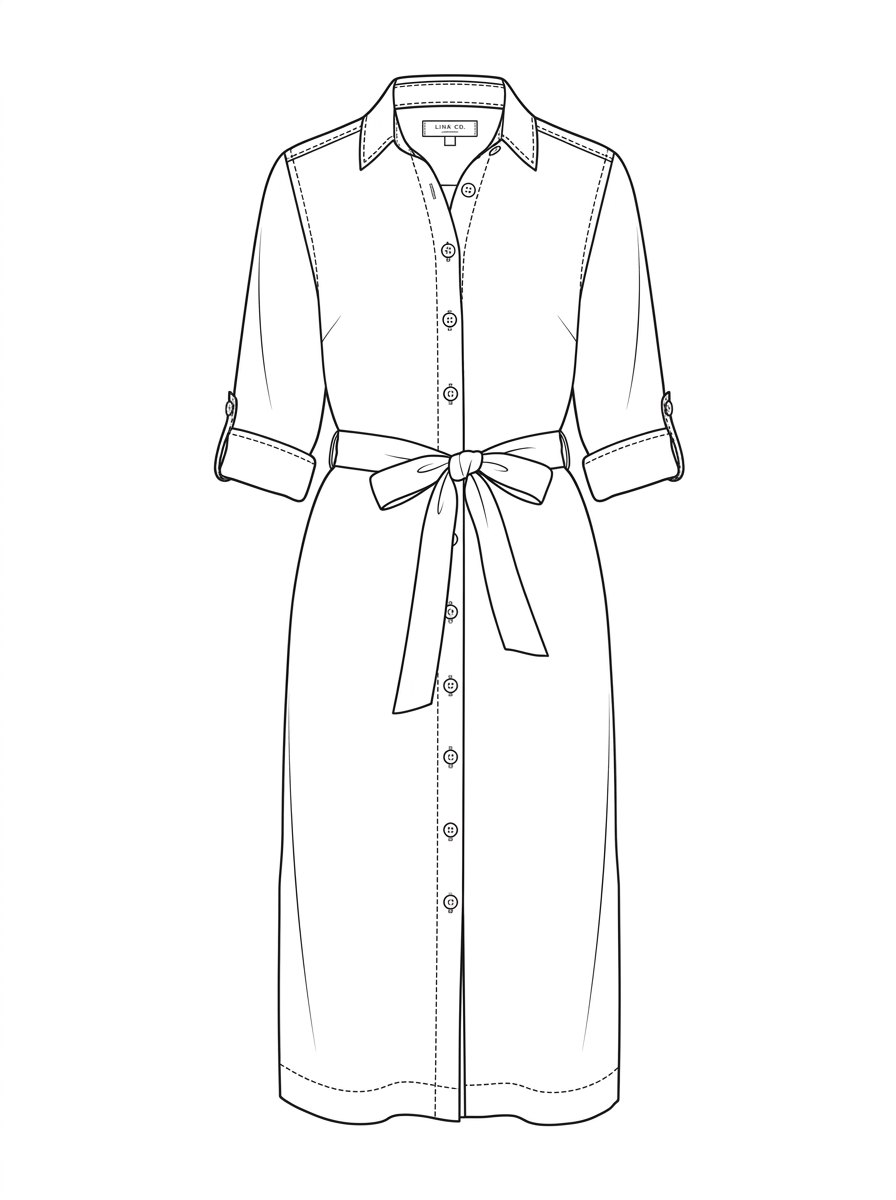
Product → Sketch turns the design into a clean front flat showing the buttons, tie belt, roll-up sleeve and topstitching. Try-On puts the same design on a model for a line sheet or a proportion check before sampling.
Part 2: Build the 14-page tech pack
Do not start from a blank page. In Templates → Complete Techpack Sets, pick the Woven Shirt set: 14 ready pages. A shirt dress is a shirt built longer, so the structure carries over and you only change the values.
Page 1: Overview
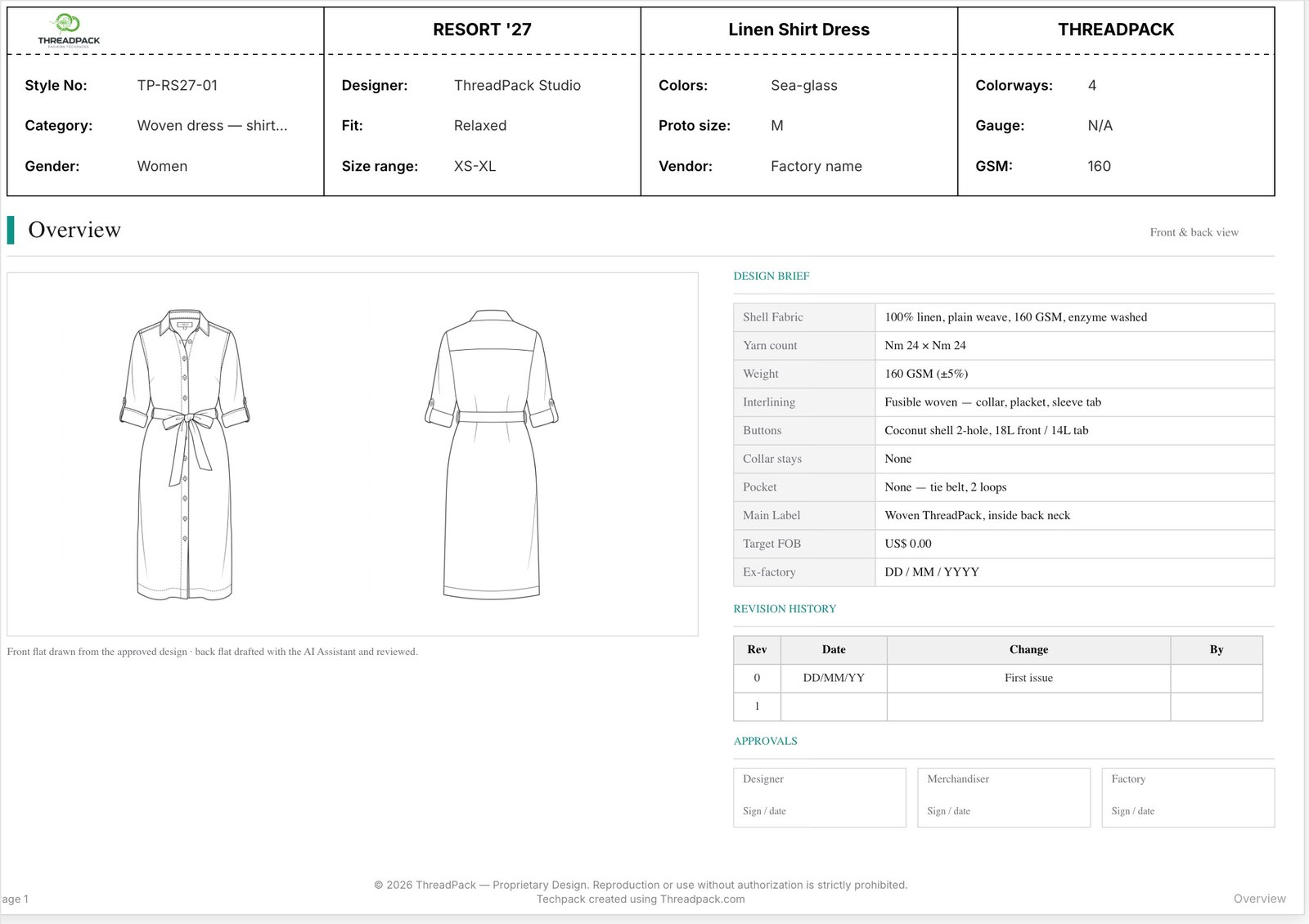
Add your logo and fill the header block once: season RESORT '27, style number TP-RS27-01, Woven dress (shirt dress), Women, Relaxed fit, XS–XL, base size M and 160 GSM. The header syncs to all 14 pages. Rewrite the design brief for linen: 100% linen plain weave, Nm 24 × Nm 24, enzyme washed, coconut-shell buttons, and a tie belt with two loops instead of a pocket. For the back flat, the AI Assistant drafted a flat from the front; page context was off, the prompt asked for no text, and the result was checked before placing.
Page 2: Flat sketch and key details
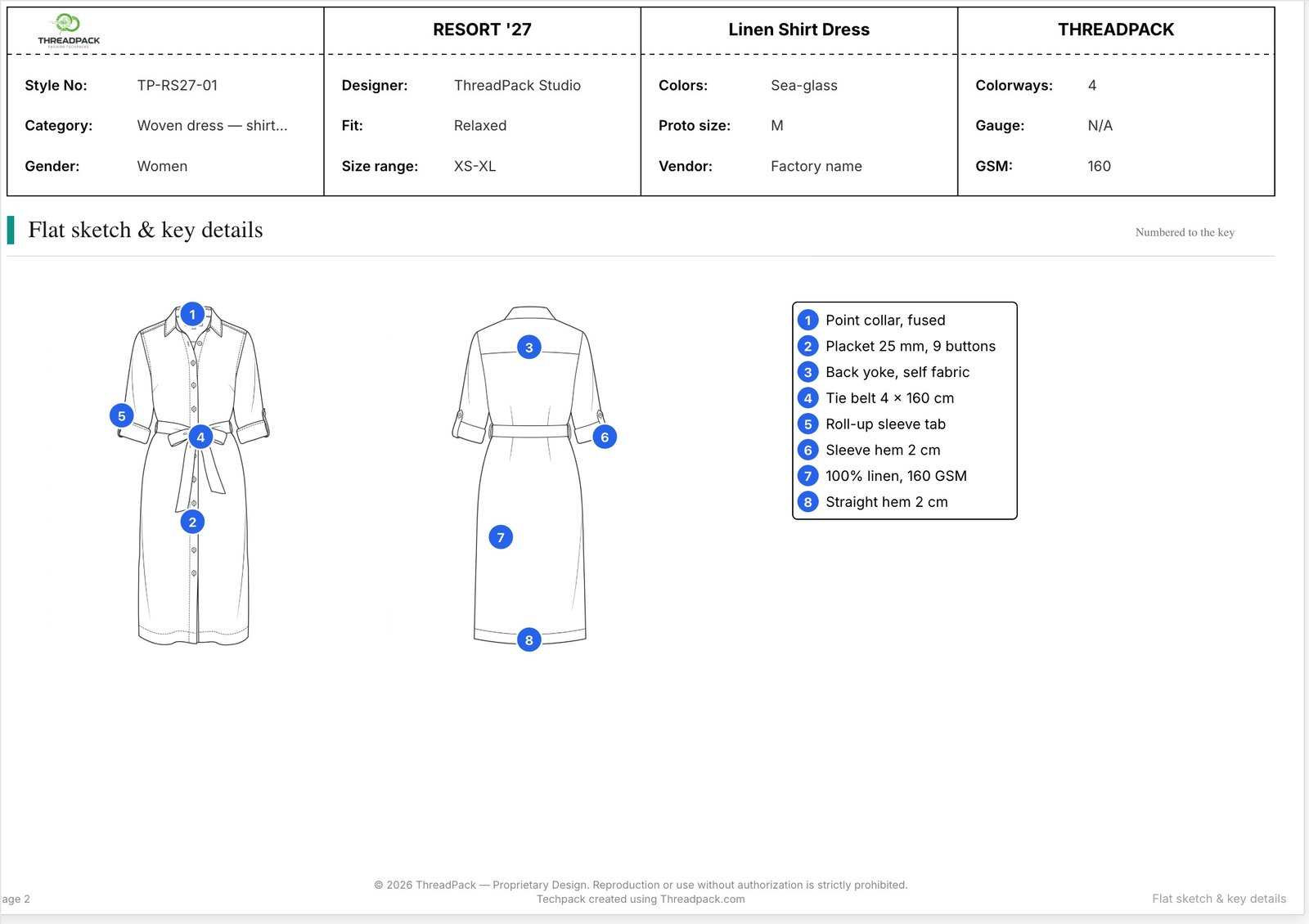
Callout pins number each feature directly on the flats: point collar (fused), 25 mm placket with 9 buttons, back yoke, tie belt 4 × 160 cm, roll-up sleeve tab, 2 cm sleeve hem, the fabric, and a 2 cm straight hem.
Page 3: Construction
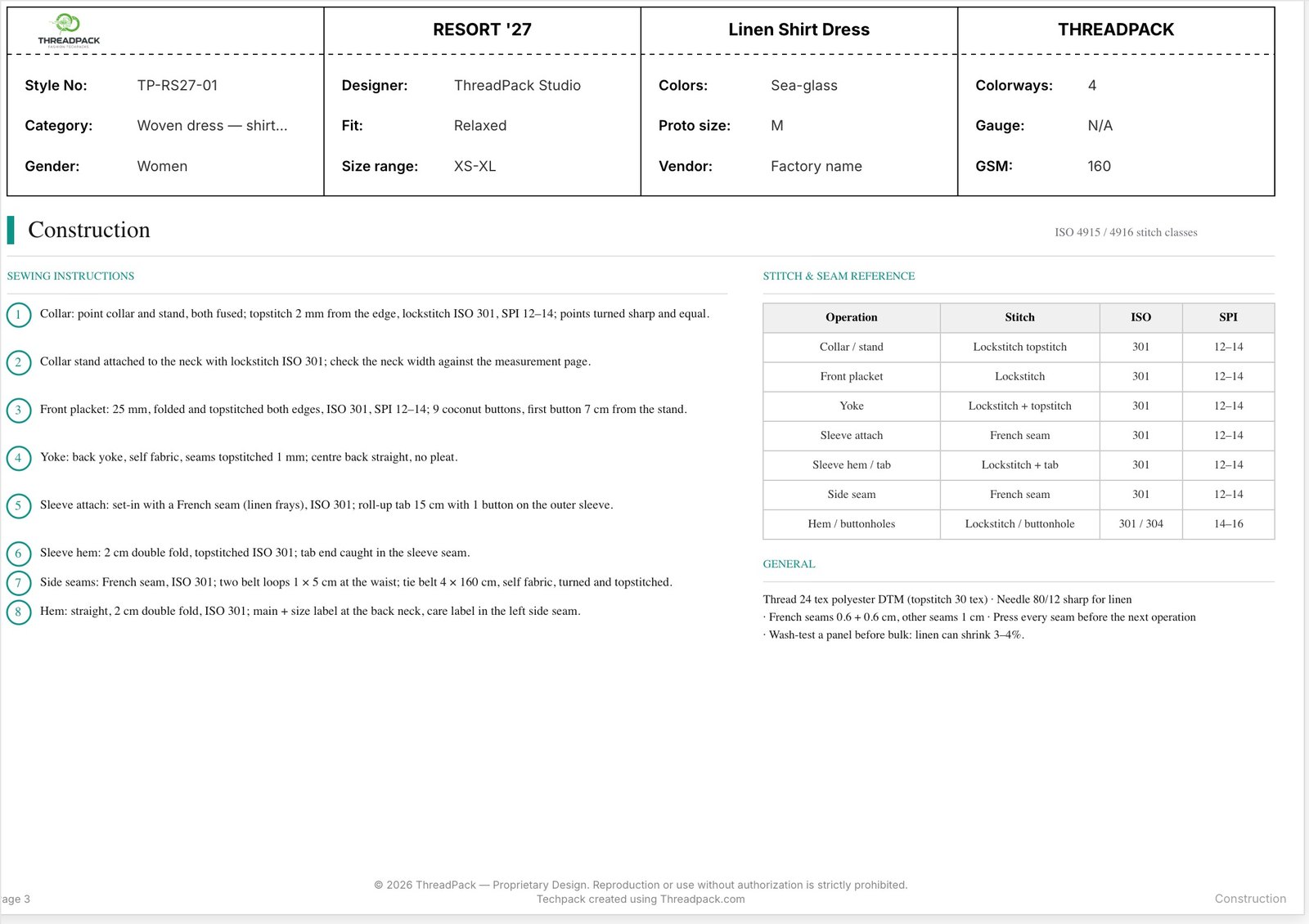
Linen frays, so the sleeves and side seams are French seams. Every seam is ISO 301 lockstitch at 12–14 stitches per inch, and the placket is topstitched on both edges. The general notes cover thread (24 tex polyester, DTM), an 80/12 needle, seam allowances and a wash test before bulk, because linen can shrink 3–4%.
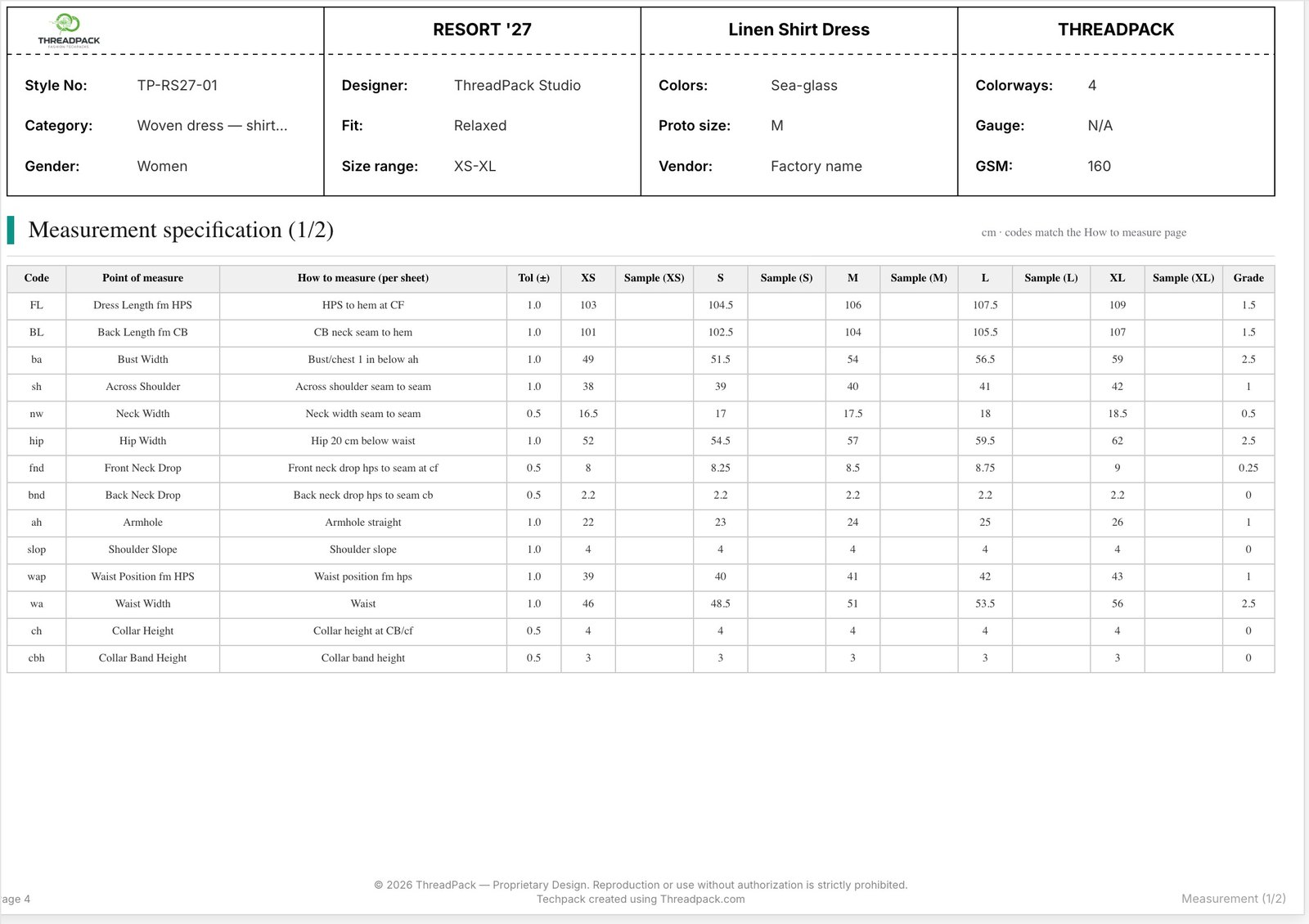
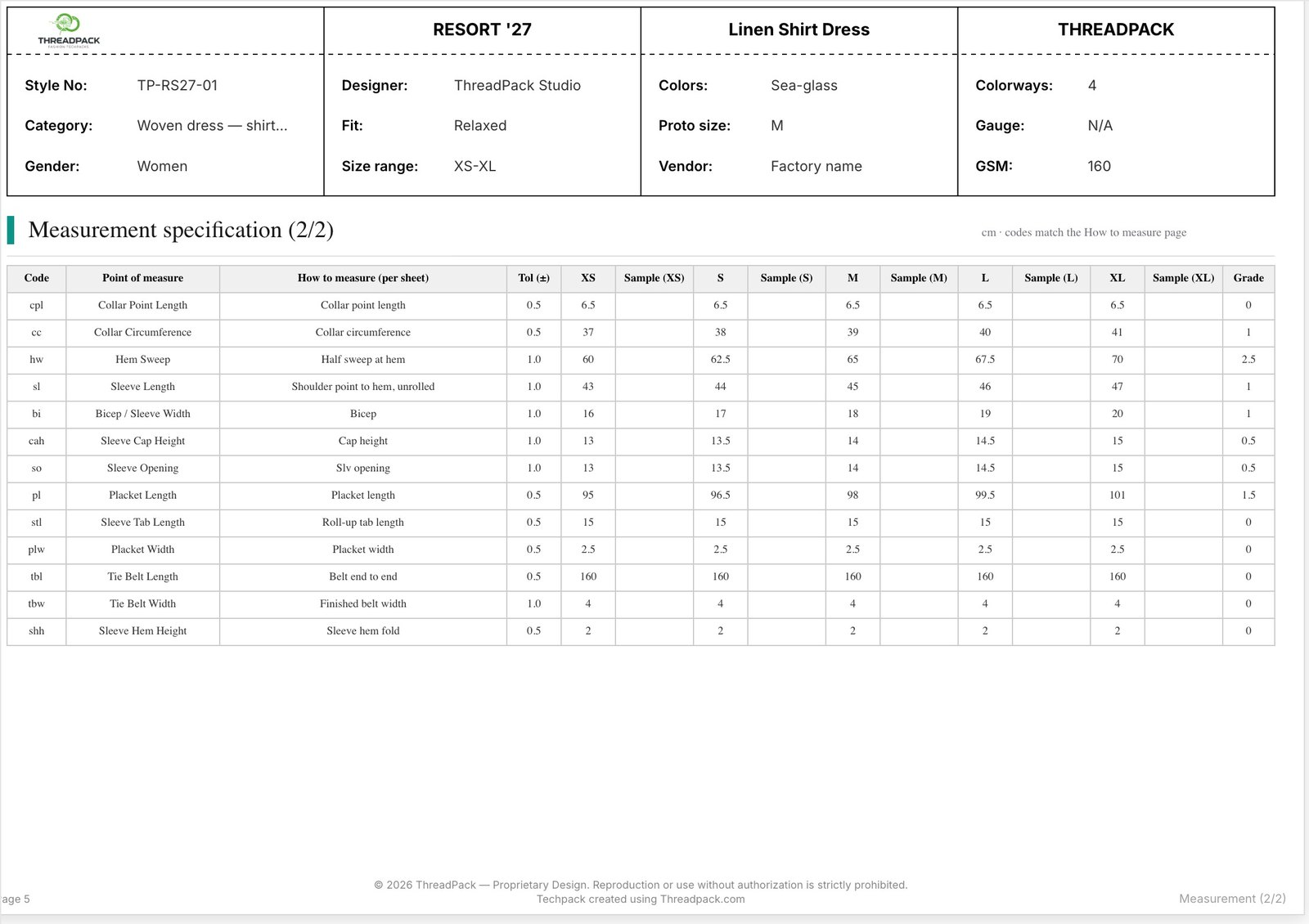
Pages 4 and 5: Measurement specification
The points of measure are already in place. Type each size from XS to XL with M as the base, plus the grade between sizes. Dress length grades by 1.5 cm; bust, waist, hip and hem sweep grade by 2.5 cm. The tie belt stays 160 × 4 cm in every size. Tolerances sit beside each point.
Page 6: Size chart and order breakdown
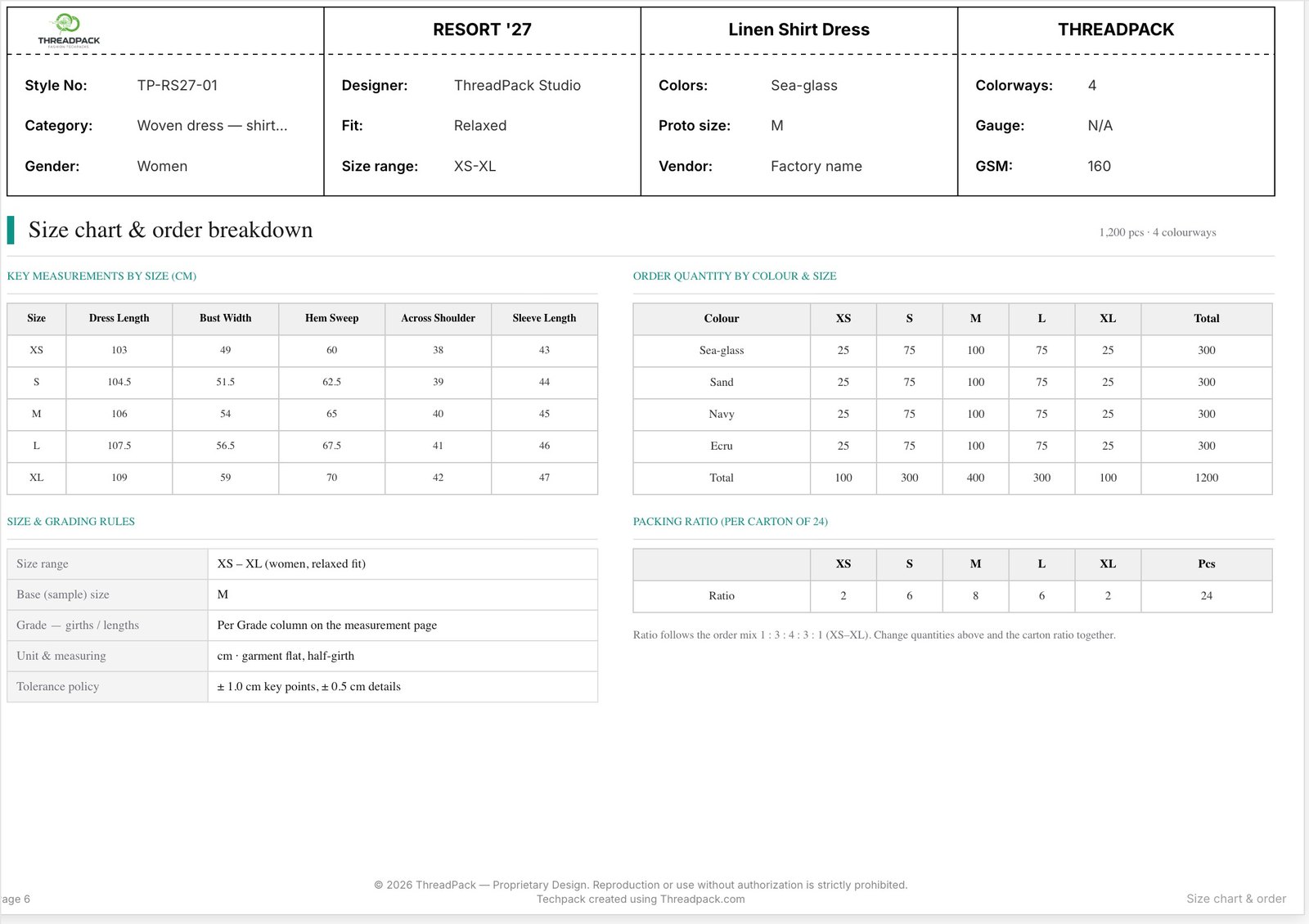
The size columns become XS–XL with M as the base size. The order quantity splits across four colourways (sea-glass, sand, navy, ecru), with a carton pack ratio of 1 : 3 : 4 : 3 : 1.
Page 7: How to measure
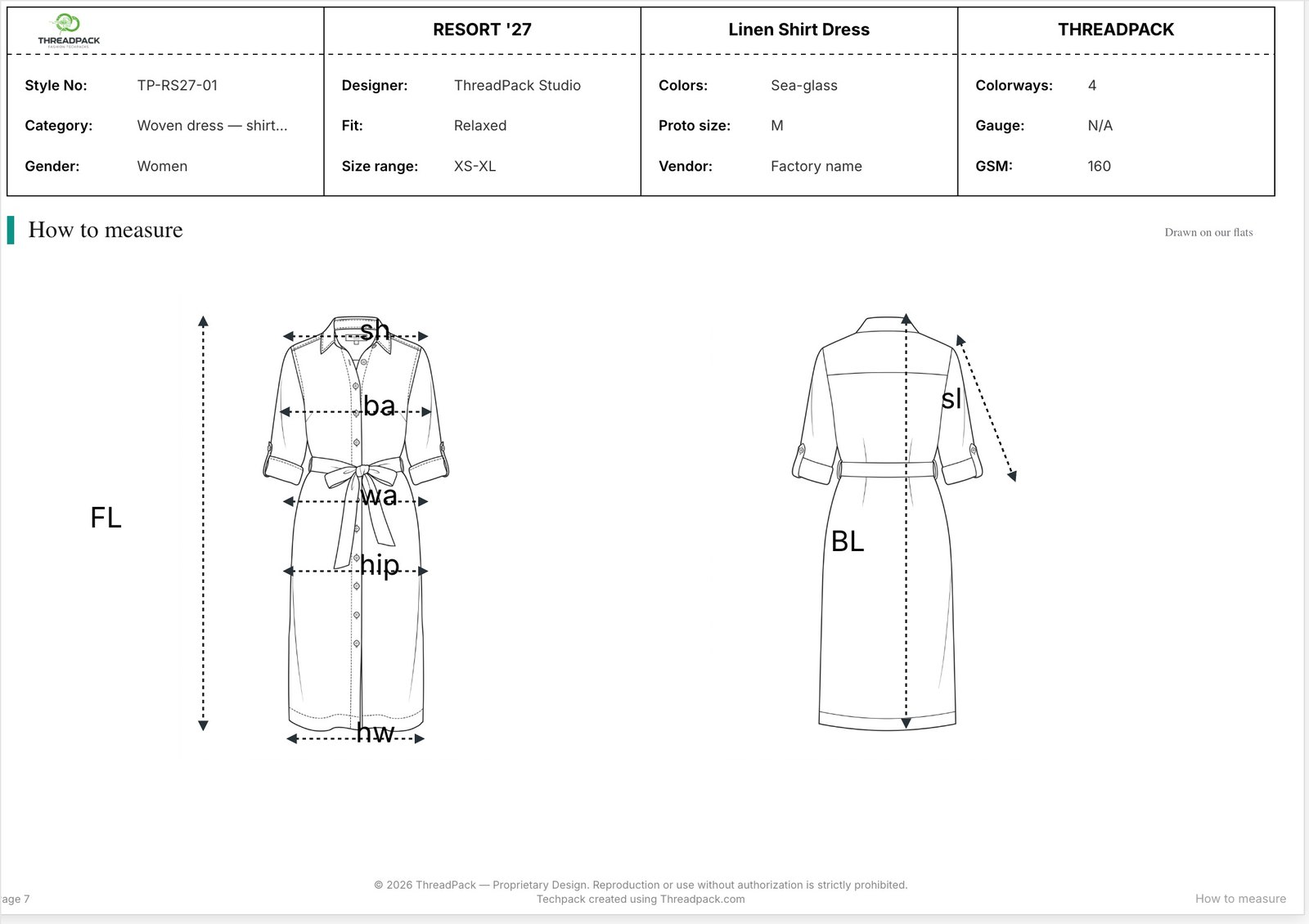
You can start from an AI diagram, but here the guide is drawn by hand on our own flats. The Arrow tool marks each measurement, and every arrow carries a code that matches the spec table (FL, BL, sh, ba, wa, hip, hw, sl). A person makes the final check, because a measuring guide is only useful if it matches the spec exactly.
Page 8: Fabric and trims
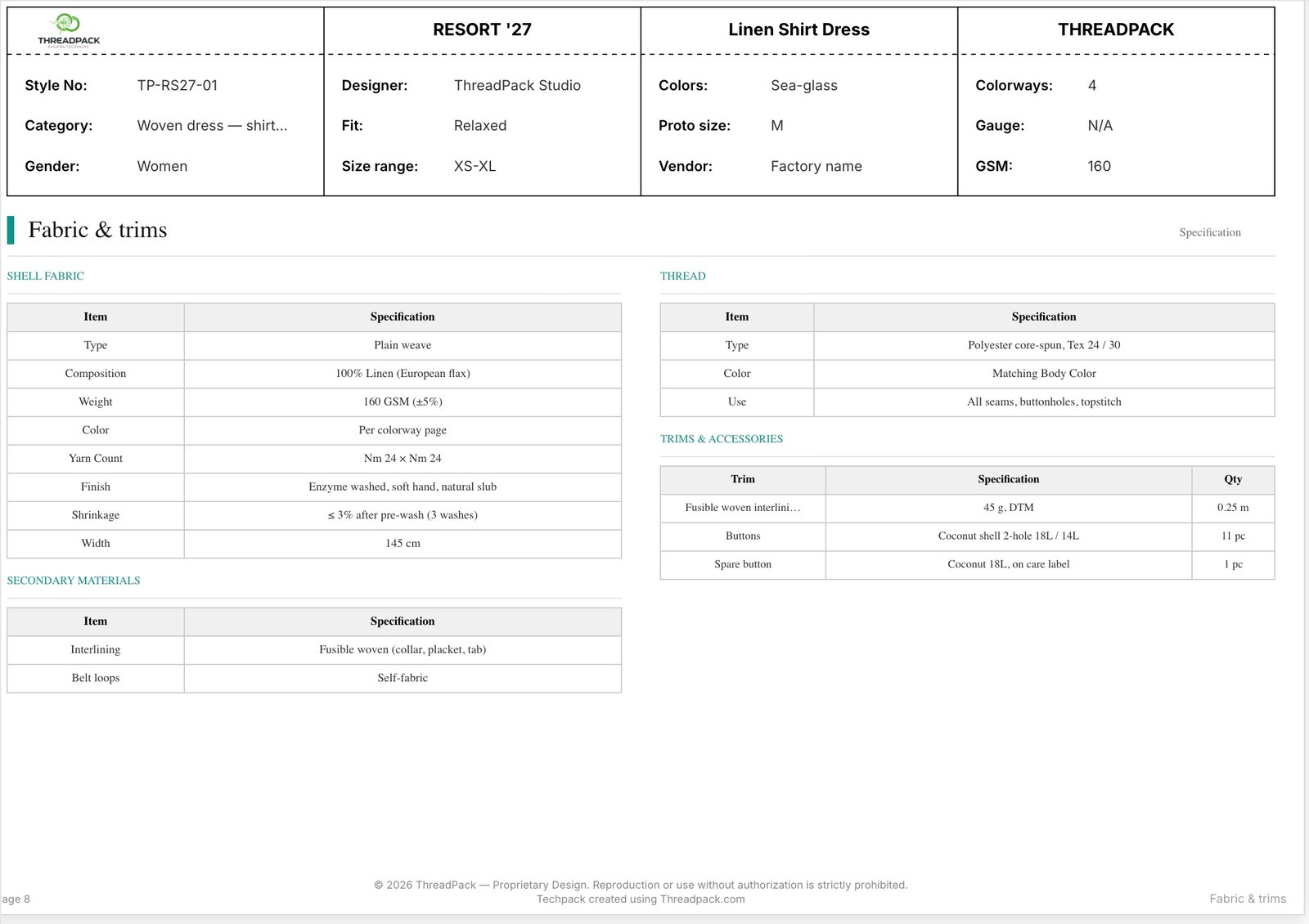
The fabric page sets out the shell fabric (composition, yarn count, weight, finish, shrinkage and width), the interlining, the thread and the coconut buttons.
Page 9: Bill of materials
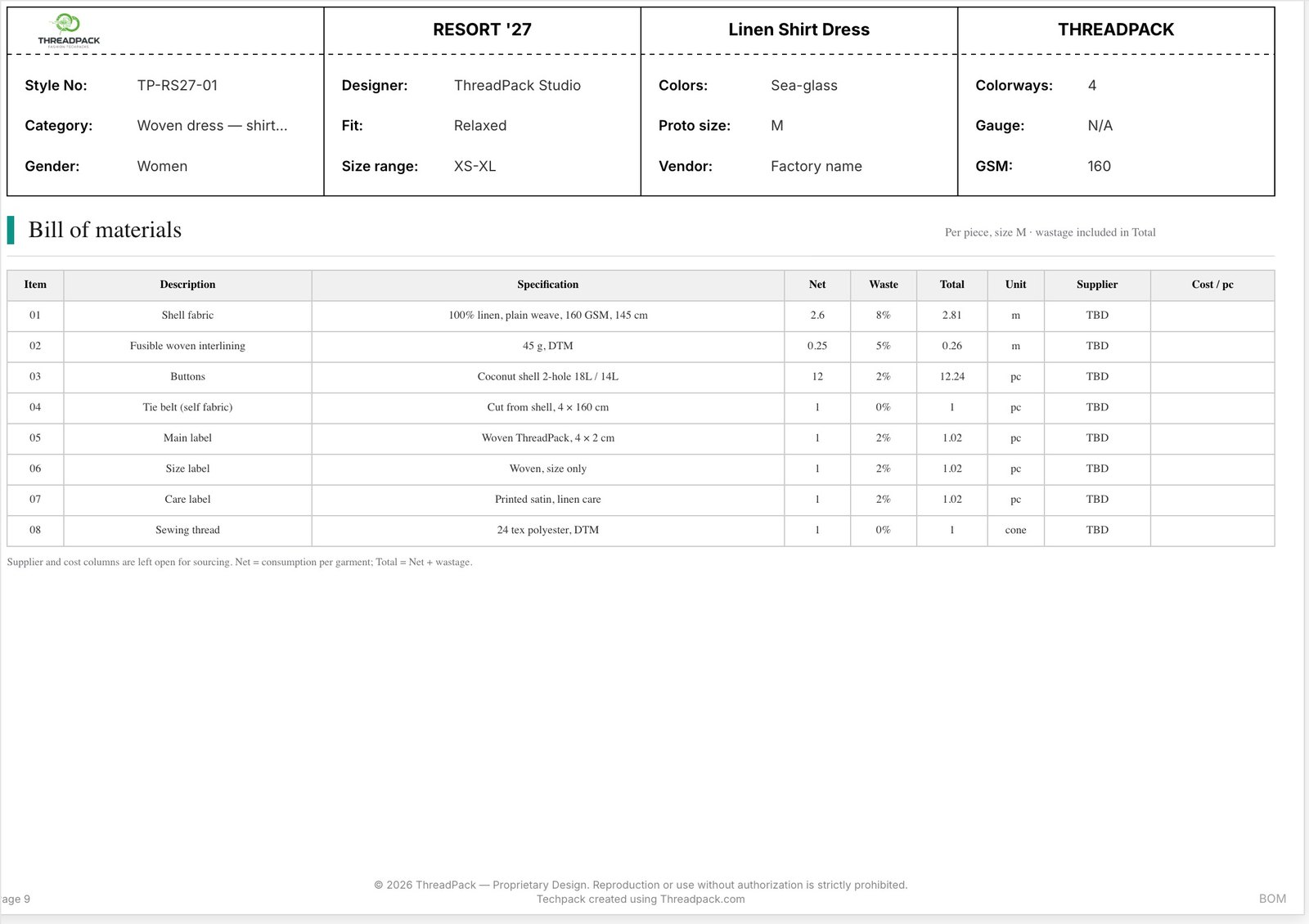
The BOM lists every component with its placement, consumption per garment and wastage, so the factory can quote without guessing.
Page 10: Colorways
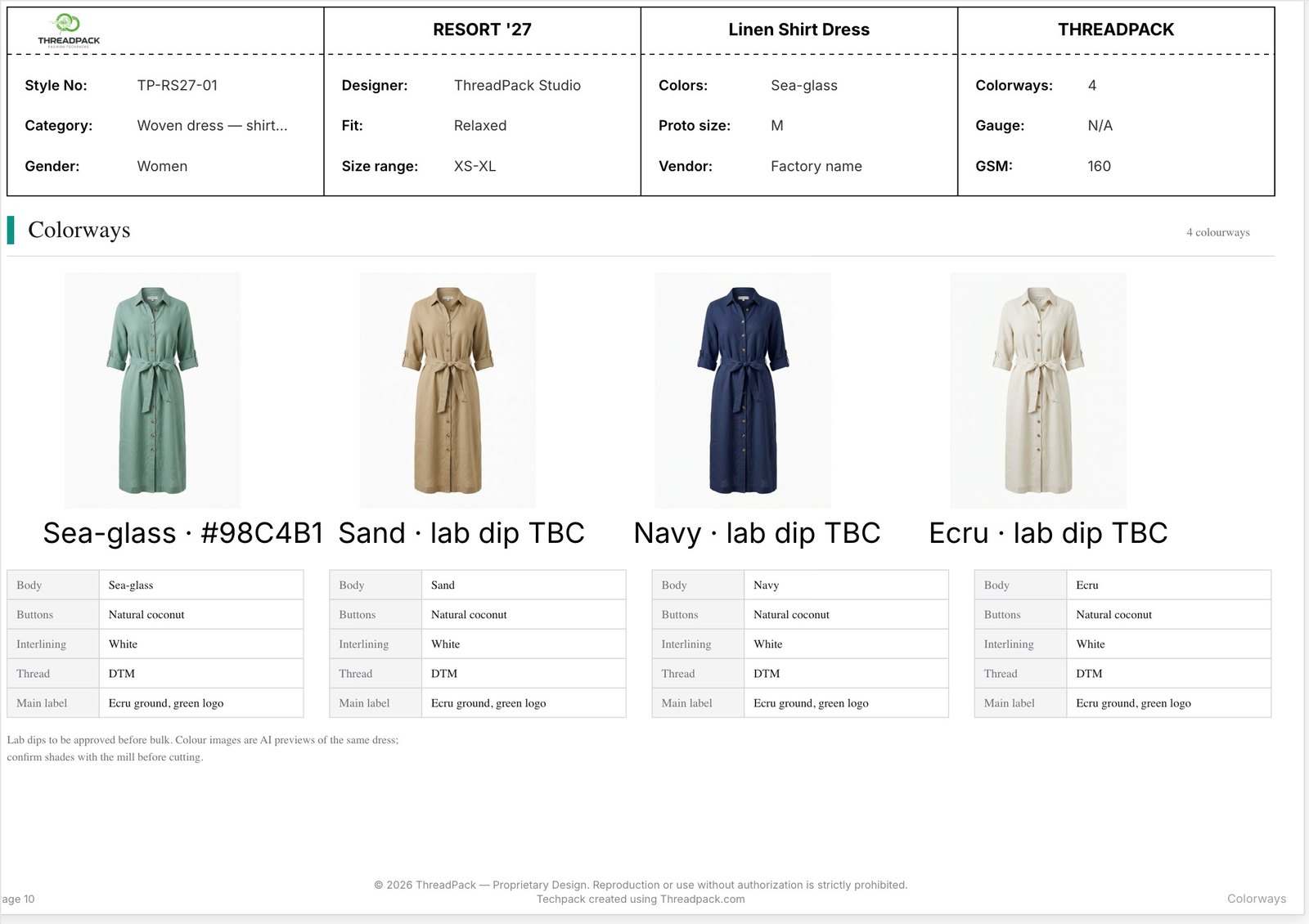
Instead of generating the dress again in new colours (and getting a slightly different dress each time), Color Edit recolours the approved design and keeps everything else identical, at one credit per colour: sand, navy and ecru. Every shade is marked lab dip TBC: the images are previews, and the mill confirms the real colour.
Page 11: Labels and artwork
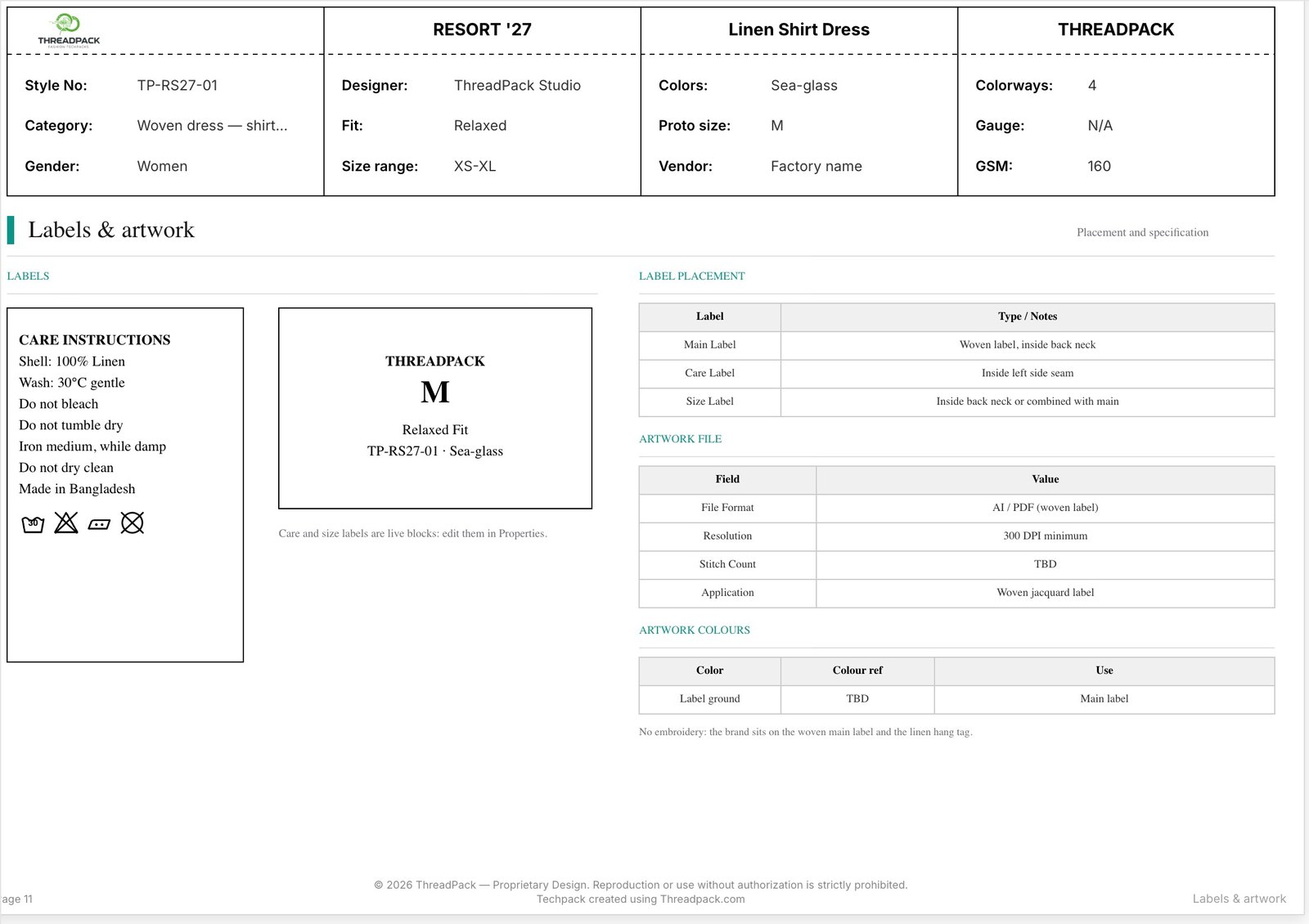
The care label and size label are live blocks edited in Properties: 100% linen, 30°C gentle wash, do not tumble dry, iron medium while damp, with matching care symbols. The brand, ThreadPack, sits on a woven main label and a linen hang tag.
Page 12: Quality control
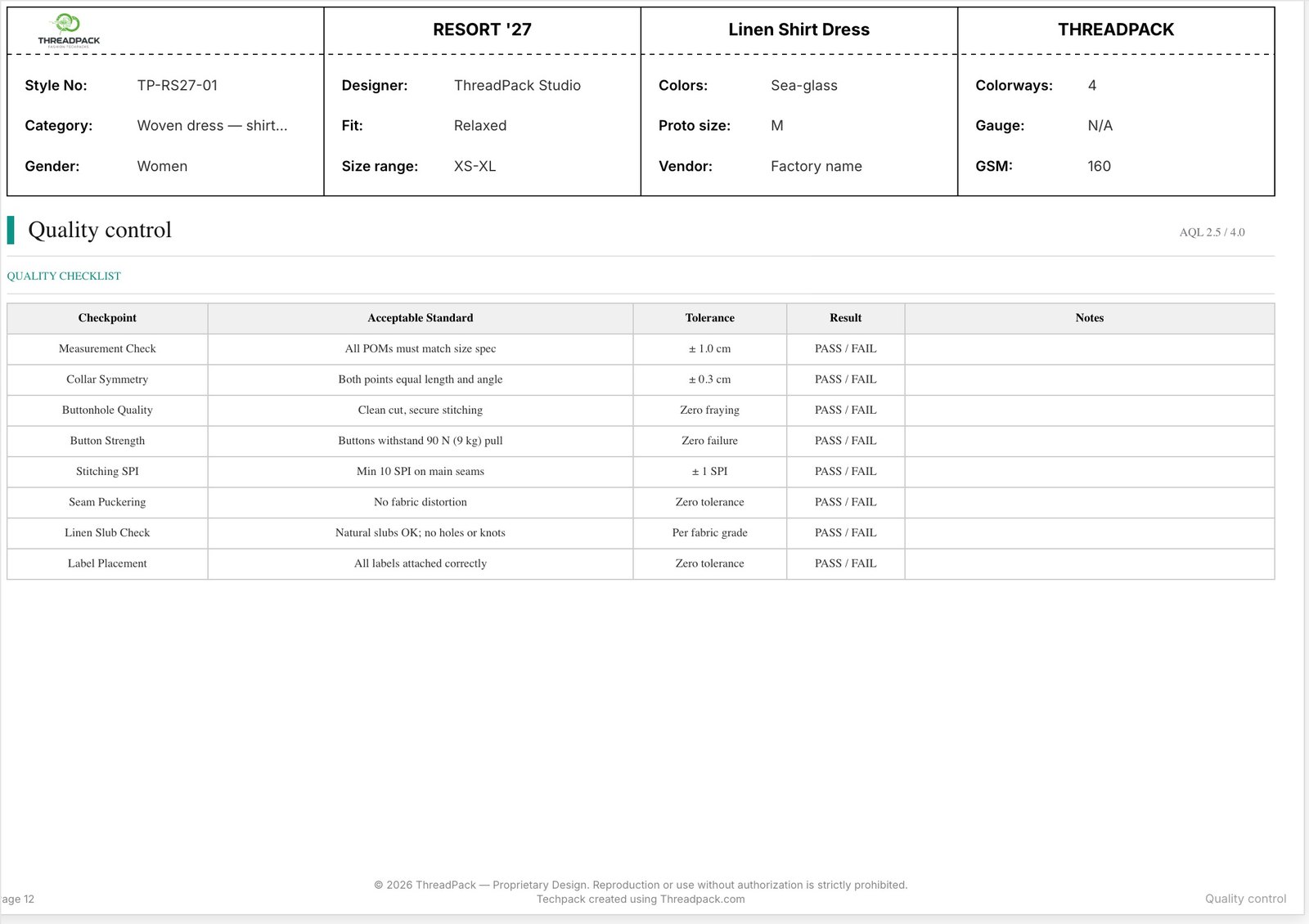
QC covers measurement tolerance, a 90 N button pull test, seam puckering and a linen slub check.
Page 13: Inspection and testing
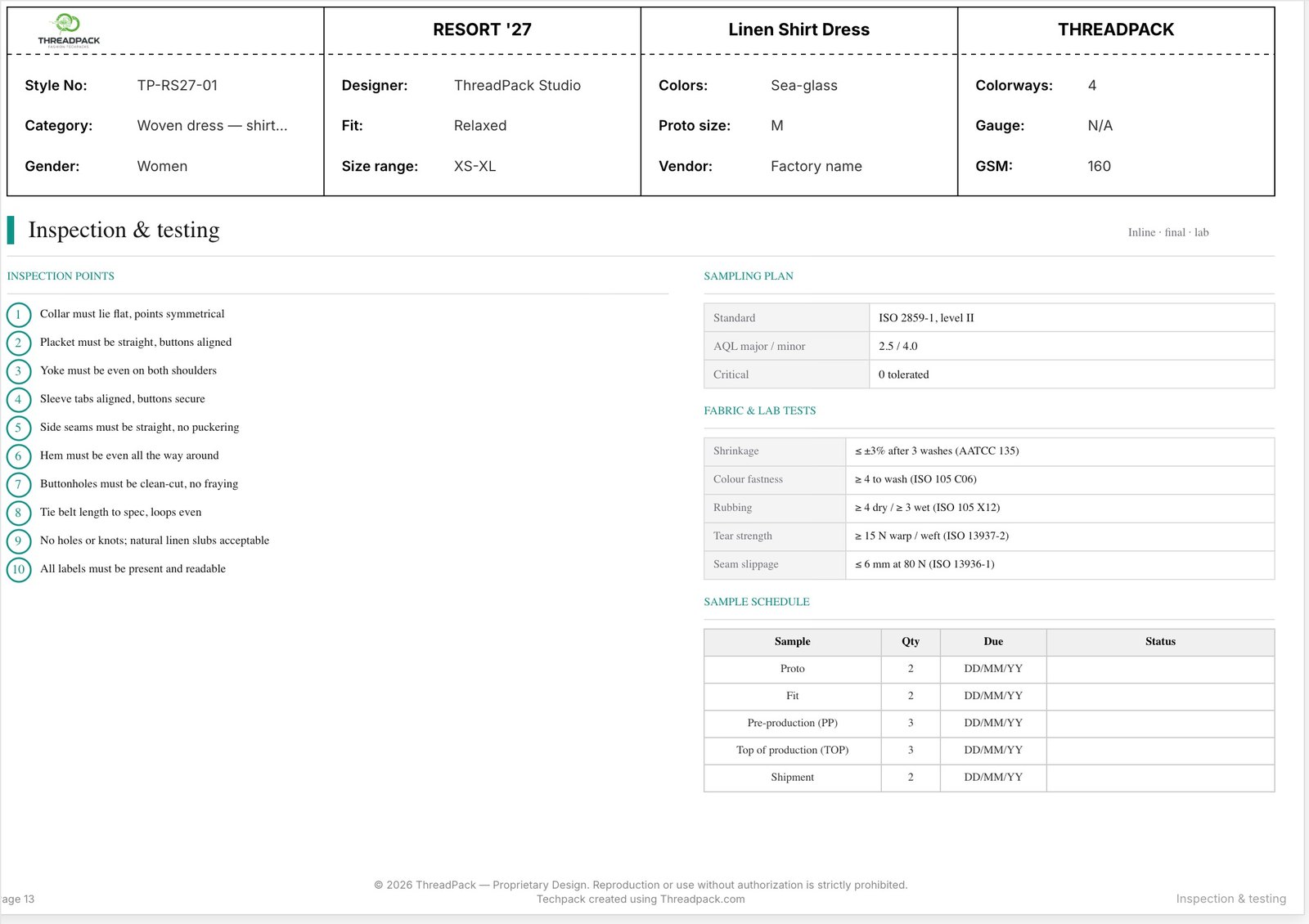
Inspection sets the sampling plan (AQL) and the fabric tests: dimensional stability, colourfastness to washing and rubbing, tear strength and seam slippage. Treat the values as standard starting points and confirm them with your mill and lab.
Page 14: Packaging
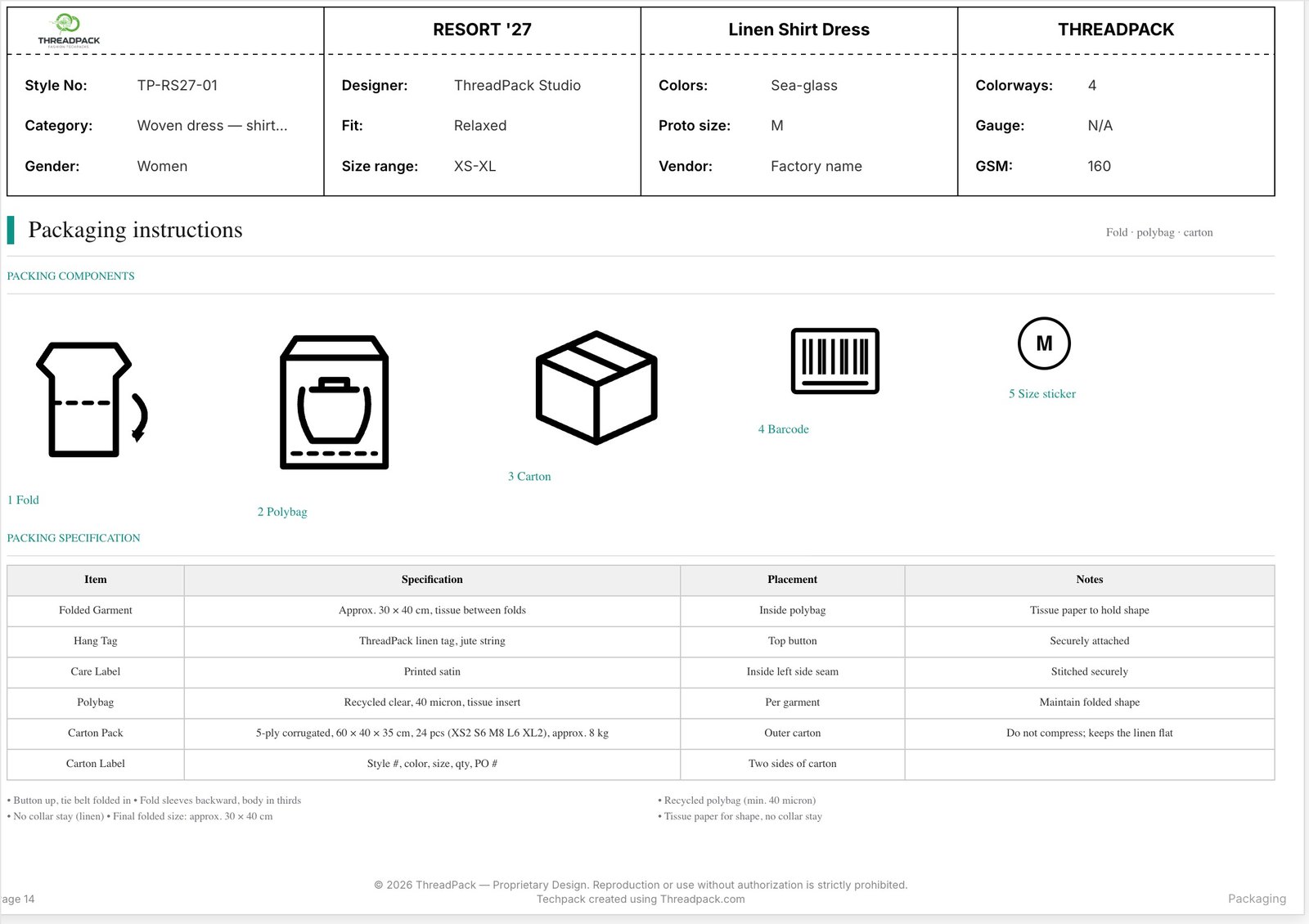
Packaging covers the fold with tissue between layers, a ThreadPack linen hang tag on jute string, a recycled 40-micron polybag and carton marks.
What AI did, and what a person decided
- AI drafted: the moodboard, three design options, the front flat, the model shot, the back flat and three colourway previews.
- A person decided: every measurement, grade, tolerance, construction note, trim, label and test value, and which AI result was good enough to keep.
That split is the point. AI gets you to a design and a first draft in minutes; the tech pack is still yours, because the factory builds from it. In ThreadPack every value stays editable, and nothing goes to the factory until you approve it.
FAQ
How many pages should a tech pack have?
For a woven dress like this one, 14 pages cover everything a factory needs: overview, flats, construction, two measurement pages, size chart, how to measure, fabric, BOM, colorways, labels, QC, inspection and packaging. Simple styles can use fewer, but never skip measurements, materials and construction.
What fabric weight is best for a linen shirt dress?
This style uses 100% linen plain weave at about 160 GSM, which is light enough for resortwear but holds a shirt-dress shape. Ask the mill to pre-wash or test shrinkage, because linen can shrink 3–4%.
Which seams should a linen dress use?
Linen frays easily, so French seams are a good choice for the side seams and sleeves, with ISO 301 lockstitch at 12–14 stitches per inch.
How do you grade a shirt dress from XS to XL?
Pick a base size (here M), measure it, then add a grade between sizes. In this tech pack, dress length grades by 1.5 cm and bust, waist, hip and hem sweep by 2.5 cm, while trims like the tie belt stay the same in every size.
Can AI make a tech pack for me?
AI can draft parts of it: flats, colourway previews and first estimates. A person should still approve every measurement, tolerance and test value, because those are what the factory cuts and sews to.
Is there a free tech pack template?
Yes. Download the complete 14-page PDF of this linen shirt dress tech pack below, or build your own from the Complete Techpack Sets in ThreadPack, free to start at threadpack.com.
Free download: the full 14-page linen shirt dress tech pack (PDF)
Free — just tell us where to send it.
Explore ThreadPack
Related resources and tools to help you move faster.